How Intent-based Segmentation Will Change Automotive Retention

Written by Sam Benbow, Head of Growth and Automotive specialist at Force24.
Think about ordering a coffee in a well-known coffee chain. The drink itself may start with a fairly simple choice, but it quickly becomes more complicated. Which coffee? What size? Which milk? Hot or iced? One syrup or two? An extra shot? Starbucks actually recently said that its drinks can be customised in more than 1 billion different ways. (Yow that is a crazy number, however I’ve checked the maths and it’s correct).
The customer does not need to fit neatly into a predefined “oat milk, iced latte, vanilla” audience before they reach the counter. Their preferences are combined to create the right result. Taken individually, none of those decisions feels particularly difficult. Combine them, though, and the number of possible drinks grows very quickly.
That variety is manageable because the choices can be brought together at the point of order, whereas in automotive this happens over a much longer period of time, some of which happens in the dark or across different systems that rarely speak to one another.
The personalisation challenge
The difficulty is not that dealerships lack these choices or data points. It is that there are too many possible combinations to manage manually, at speed and across an entire customer database. Individually, these are all manageable data points. Combined across thousands of customers, they create more possible journeys than a marketing team could realistically build and maintain by hand.
A marketer could try to build a separate segment and journey for every variation, but the number of possible routes would soon become unmanageable. This is where the limitations of traditional list and rules-based segmentation become clear, and where AI-supported, intent-based segmentation offers a more practical way forward.
Going back to the analogy, a coffee chain does not need to create and store a separate menu item for every possible drink before a customer orders it. It brings the available ingredients together around that person’s preferences at the right moment.
That is the opportunity behind AI-driven, intent-based segmentation. Rather than asking marketers to build a separate list, set of rules and journey for every possible customer combination, AI can help interpret the available signals, calculate likely intent and select the most relevant route from a controlled set of approved options. This is where the limitations of traditional list and rules-based segmentation become clear, and where a more responsive approach begins to make practical sense.
The limits of list and rules-based segmentation
From what I’ve seen, list-based segmentation has served automotive marketers fairly well. It brings order to large databases and makes it possible to build campaigns around clear lifecycle moments. For example, customers approaching finance end can enter a renewal segment. Those due a service or MOT can receive a reminder, and previous buyers/lapsed customers/event attendees can each be grouped and communicated with differently.
However, rules then determine what happens next. A customer meets a condition, a trigger fires and a predefined journey begins. This works well when the audience and required response are straightforward, but the difficulty appears as the number of variables grows.
Some of the most common limitations I’ve heard from marketing teams are:
1. Every condition has to be defined manually – Marketers must anticipate the scenario, build the audience and map the journey in advance
2. One trigger often leads to one fixed route – Customers may continue through the same journey even when their interests or behaviour begin to change.
3. Journeys require constant maintenance – Stock changes, content dates, offers expire and rules need to be reviewed or rebuilt.
4. Only the more obvious scenarios tend to be covered – High-priority journeys are created first, while smaller or less predictable opportunities remain untouched.
5. Relevance scales through more manual work – Supporting more combinations usually means more lists, rules, branches and content variants.
6. Customers are simplified to fit the logic – Two people in the same segment may have very different levels of interest, but the journey may treat them identically.
7. Compliance can add further complexity – Data use, brand controls and AI safeguards all need to be considered as journeys become more sophisticated.
To be clear, we’re not saying here that lists and rules are ineffective. They remain valuable for organising customer data and managing predictable lifecycle activity. The issue is that they struggle to account for the full range of choices, behaviours and changing interests within a modern automotive database.
Rules-based segmentation versus intent-based segmentation
The move towards intent-based segmentation is not about discarding everything that came before. It is about moving from journeys that marketers must define in full to journeys that can respond as the customer changes.
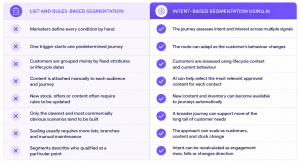
A list might tell you that a customer is nine months away from finance end. Intent-based segmentation considers that information alongside what they are doing now.
Are they repeatedly viewing a newer version of their current model? Have they moved from browsing petrol vehicles to looking at hybrids? Have they used a finance calculator, checked the value of their current car or clicked through to relevant stock?
A second customer may have exactly the same finance end date but show none of those behaviours. Under a fixed rules-based approach, both could receive the same sequence. Under an intent-based approach, the journey can recognise that they are in very different places.
Get in touch
Give us a shout.
Ready to take your marketing up a gear? Give us a call or drop us an email – our UK-based team is on hand to help.
Talk to us