Master intent-spotting at FWD:Thinking Live in London on 20-08-2026. Tickets are available now!

Master intent-spotting at FWD:Thinking Live in London on 20-08-2026. Tickets are available now!

Master intent-spotting at FWD:Thinking Live in London on 20-08-2026. Tickets are available now!

Master intent-spotting at FWD:Thinking Live in London on 20-08-2026. Tickets are available now!

How Intent-based Segmentation Will Change Automotive Retention

Written by Sam Benbow, Head of Growth and Automotive specialist at Force24.


Think about ordering a coffee in a well-known coffee chain. The drink itself may start with a fairly simple choice, but it quickly becomes more complicated. Which coffee? What size? Which milk? Hot or iced? One syrup or two? An extra shot? Starbucks actually recently said that its drinks can be customised in more than 1 billion different ways. (Yow that is a crazy number, however I’ve checked the maths and it’s correct).

The customer does not need to fit neatly into a predefined “oat milk, iced latte, vanilla” audience before they reach the counter. Their preferences are combined to create the right result. Taken individually, none of those decisions feels particularly difficult. Combine them, though, and the number of possible drinks grows very quickly.

That variety is manageable because the choices can be brought together at the point of order, whereas in automotive this happens over a much longer period of time, some of which happens in the dark or across different systems that rarely speak to one another.


The personalisation challenge 

The difficulty is not that dealerships lack these choices or data points. It is that there are too many possible combinations to manage manually, at speed and across an entire customer database. Individually, these are all manageable data points. Combined across thousands of customers, they create more possible journeys than a marketing team could realistically build and maintain by hand.

A marketer could try to build a separate segment and journey for every variation, but the number of possible routes would soon become unmanageable. This is where the limitations of traditional list and rules-based segmentation become clear, and where AI-supported, intent-based segmentation offers a more practical way forward.

Going back to the analogy, a coffee chain does not need to create and store a separate menu item for every possible drink before a customer orders it. It brings the available ingredients together around that person’s preferences at the right moment.

That is the opportunity behind AI-driven, intent-based segmentation. Rather than asking marketers to build a separate list, set of rules and journey for every possible customer combination, AI can help interpret the available signals, calculate likely intent and select the most relevant route from a controlled set of approved options. This is where the limitations of traditional list and rules-based segmentation become clear, and where a more responsive approach begins to make practical sense.


The limits of list and rules-based segmentation

From what I’ve seen, list-based segmentation has served automotive marketers fairly well. It brings order to large databases and makes it possible to build campaigns around clear lifecycle moments. For example, customers approaching finance end can enter a renewal segment. Those due a service or MOT can receive a reminder, and previous buyers/lapsed customers/event attendees can each be grouped and communicated with differently.

However, rules then determine what happens next. A customer meets a condition, a trigger fires and a predefined journey begins. This works well when the audience and required response are straightforward, but the difficulty appears as the number of variables grows.

Some of the most common limitations I’ve heard from marketing teams are:

1. Every condition has to be defined manually  Marketers must anticipate the scenario, build the audience and map the journey in advance


2. One trigger often leads to one fixed route – Customers may continue through the same journey even when their interests or behaviour begin to change.


3. Journeys require constant maintenance – Stock changes, content dates, offers expire and rules need to be reviewed or rebuilt.


4. Only the more obvious scenarios tend to be covered – High-priority journeys are created first, while smaller or less predictable opportunities remain untouched.


5. Relevance scales through more manual work – Supporting more combinations usually means more lists, rules, branches and content variants.


6. Customers are simplified to fit the logic – Two people in the same segment may have very different levels of interest, but the journey may treat them identically.


7. Compliance can add further complexity  Data use, brand controls and AI safeguards all need to be considered as journeys become more sophisticated.


To be clear, we’re not saying here that lists and rules are ineffective. They remain valuable for organising customer data and managing predictable lifecycle activity.
The issue is that they struggle to account for the full range of choices, behaviours and changing interests within a modern automotive database.


Rules-based segmentation versus intent-based segmentation

The move towards intent-based segmentation is not about discarding everything that came before. It is about moving from journeys that marketers must define in full to journeys that can respond as the customer changes.
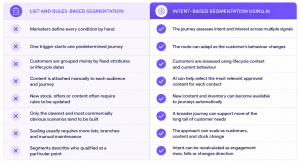
 

A list might tell you that a customer is nine months away from finance end. Intent-based segmentation considers that information alongside what they are doing now.

Are they repeatedly viewing a newer version of their current model? Have they moved from browsing petrol vehicles to looking at hybrids? Have they used a finance calculator, checked the value of their current car or clicked through to relevant stock?

A second customer may have exactly the same finance end date but show none of those behaviours. Under a fixed rules-based approach, both could receive the same sequence. Under an intent-based approach, the journey can recognise that they are in very different places.

Let me take this opportunity for a mid-read plug. We’ve been talking a lot about buyer intent at Force24 recently, so much that we decided to properly dig into it, creating a data-backed report for automotive marketers on how buyers really behave and how to spot intent earlier.

Most of us are still wary of AI, but we can’t accomodate every customer without it

AI is often presented as the answer to almost every marketing problem, so some scepticism is understandable. Many teams are still deciding where it genuinely adds value, what they are comfortable handing over and whether their data and internal processes are ready for it. There are also valid questions around compliance, brand control and the quality of the decisions being made. However, there is a practical reality that is difficult to ignore. Marketers cannot manually assess every signal, understand every possible combination of needs and build an individual journey for every customer in the database.

There are simply too many variables. A single customer may have a current vehicle, a finance term, a preferred dealership, a history of event attendance, a changing pattern of website visits, different levels of email engagement and an interest in several models. Multiply that across tens or hundreds of thousands of customers and it quickly becomes impossible to manage through lists and hand-built rules alone. That is where AI becomes useful rather than fashionable. Its role is not to replace the marketer or make unchecked decisions, instead it’s to process complexity at a scale that people cannot, helping calculate likely intent from factors such as web engagement, purchase history, email activity, finance term data, stock interest, location and previous dealership interactions. Here, the marketer still decides what good looks like. They control the available content, the commercial priorities, the tone, the brand safeguards and the point at which a customer should move from nurture to a sales conversation. AI helps apply those decisions across the full database, rather than only the small number of scenarios a team has had time to build manually.


How AI will make intent-based segmentation managable at scale

The central challenge with intent is volume. A marketer could manually review the recent activity of a handful of customers, but that becomes impossible across a large database. Each customer may generate signals across the website, email, finance tools, events, dealership systems and previous transactions.

AI helps by assessing those signals together and continually estimating the type and strength of intent each customer appears to be showing. That calculation could draw on factors such as:

  1. Recent website engagement
  2. The frequency and recency of visits
  3. Vehicles, models or fuel types viewed
  4. Email clicks and changes in engagement
  5. Purchase and enquiry history
  6. Current vehicle ownership
  7. Finance term and expected renewal dates
  8. Equity or part-exchange information
  9. Event bookings and attendance
  10. Previous service or dealership interactions
  11. Stock availability and location
  12. Periods of inactivity followed by renewed interest

With these, we can see that no single signal needs to carry the whole decision. A customer opening an email once may not mean very much, whereas a customer approaching renewal who has visited the website several times, repeatedly viewed the same model, explored finance and checked part-exchange options is showing a much stronger pattern. AI can help calculate that difference consistently across the database. It of course would then continue recalculating intent as new activity takes place over time.

This allows customers to move between different levels or types of intent rather than remaining fixed within one list. Someone may begin with general interest, develop a clear preference for a model, pause their research and return several weeks later with stronger finance-related behaviour. The journey you’ve set in place can respond accordingly, quickly and efficiently.


Better timing should also mean better messaging

The value of intent is not only in deciding when to communicate. It should also influence what the customer receives. For examples, someone casually browsing several vehicles may not need an immediate sales message. Helpful content, buying guides, model comparisons or information about what has changed since their last purchase may be more appropriate.

A customer repeatedly viewing the same vehicle may be ready for something more specific, such as matching stock, similar alternatives, finance examples or a test drive invitation. Someone with positive equity and a maturing finance agreement may benefit from a message focused on renewal options or the potential value of their current vehicle.

A previous enquiry who did not buy, but has recently started browsing again, might respond better to a fresh stock alert, price change or event invitation linked to their earlier interest. The same principle applies when customers stop engaging. Inactivity can also influence the journey, signalling that the customer may need a different message, a different channel or simply more time.

This is where personalisation becomes more meaningful. It moves beyond inserting a first name into a standard email and instead considers the customer’s vehicle, ownership stage, likely finance position, enquiry history and recent behaviour.


A more manageable approach for marketers

Intent-based segmentation can sound more complicated than list building, but it should ultimately make marketing easier to manage.

List and rules-based programmes often grow over time into a large collection of journeys, audience conditions and one-off campaigns. Each new scenario can require another segment, another branch and another communication route. This means the most obvious or commercially valuable scenarios are usually built first, while many smaller audience opportunities remain untouched because there is not enough time to create and maintain a separate journey for each one. A more responsive approach reduces the need to predict and manually build every possible path in advance.

Rather than creating an entirely new campaign for every customer type, marketers can manage a stronger collection of approved content, offers, stock, events and information that can be matched to customers according to their interests and behaviour. The marketer still controls the content, tone, compliance and commercial priorities. The difference is that the journey can become more flexible in how that content is selected and presented. This leaves more time for strategy, creativity and improving the customer experience, rather than continually adding and maintaining more rules.


Lists provide context but intent will give movement

Lists will continue to play an important role, for at least a while.. They help marketers understand who customers are, what they own and where they sit within the lifecycle.

Intent adds a clearer view of what may be changing. It helps distinguish between a customer who qualifies for a campaign and one who is becoming commercially relevant now. It also gives marketing teams a better way to decide who should remain in nurture, who needs different content and when sales should become involved.

The shift is therefore not from structure to automation without control. It is from static segmentation to a model that can respond to more choices, more signals and more individual customer journeys than a marketing team could reasonably manage by hand.

That is where AI-driven intent-based segmentation becomes valuable. It makes it possible to handle complexity without asking marketers to build and maintain every possible combination themselves.


If intent is an area you’d like to read more about, our latest research piecet explores how modern buying behaviour is changing and what automotive brands can do to spot intent earlier and respond more effectively. It’s called The Reality of Buyer Intent’, which is available to download now. If you’d like to read more about how Force24 works with dealerships, head here.

Back to FWD: Thinking
Get in touch

Give us a shout.

Ready to take your marketing up a gear? Give us a call or drop us an email – our UK-based team is on hand to help.

Talk to us